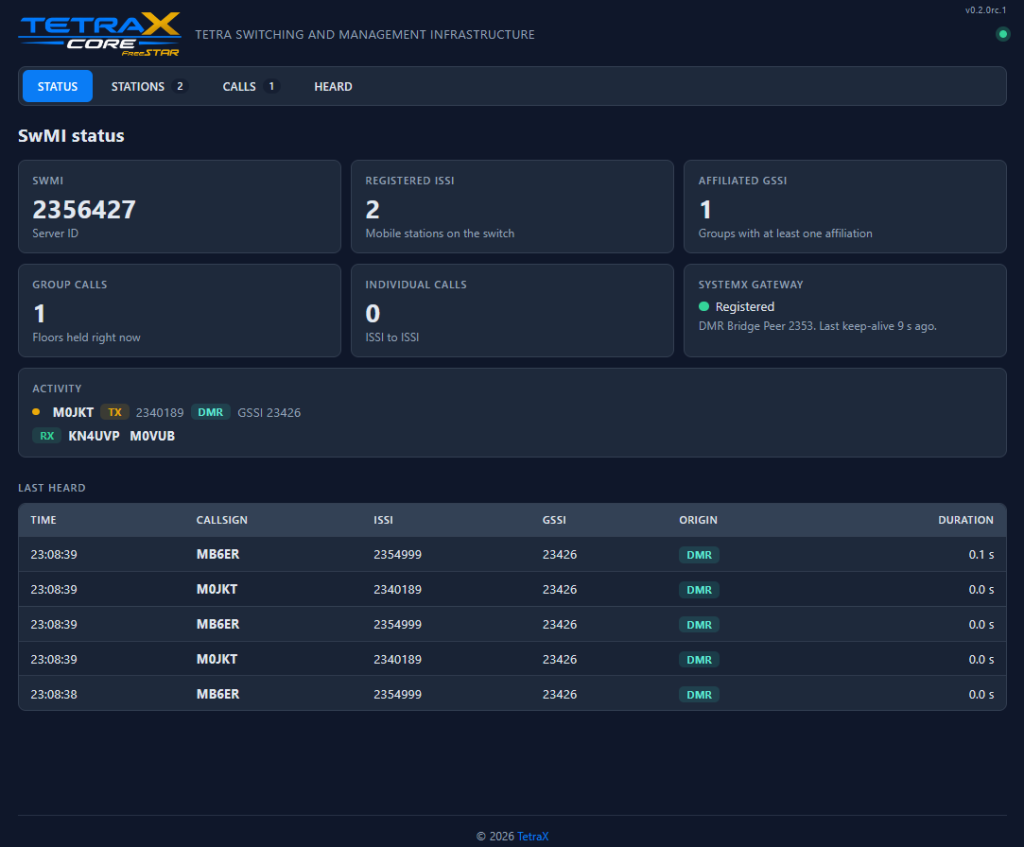
Tetra SwMI Core
TetraX
Tetra
TetraX
What is Tetra?
TETRA (Terrestrial Trunked Radio) is a secure digital two-way radio standard primarily used by emergency services, the military, public transport agencies and experimental amateur radio enthusiasts
What is TetraX?
TetraX is FreeSTAR’s TETRA switch. The SwMI is at tetra.freestar.network. Apps such as Z3DMR and base stations such as FlowStation and Bluestation log in with Brew protocol. An app / terminal logs in with a 7-digit amateur DMR ID, and that number is its ISSI. A cell logs in as that ID plus a 2-digit suffix. TetraX registers those radios, keeps their group affiliations (GSSI), and switches group calls and individual calls between them, including late entry onto a call already in progress, a higher-priority transmission taking the floor, and short data messages. A radio that moves to another cell is dropped by the cell it left. ISSI 9990 is the local parrot. Group speech can also be transcoded onto the FreeSTAR SystemX DMR network over a dedicated trunk. A public dashboard shows who is registered, the groups they are listening to, the cell a radio is on, and calls in progress.
Frequently asked questions?
Do I need a TETRA radio?
No. A Brew app such as Z3DMR is enough. A real radio needs a base station, such as FlowStation or Bluestation, logged into the switch. The phone or the cell is the Brew client. The switch never sees the air interface.
What is my ISSI?
Your ISSI is your 7-digit amateur DMR ID. There is no separate TETRA number. A second radio or a second phone needs a second DMR ID from RadioID.
What is a GSSI?
A GSSI is a talkgroup. You affiliate to the groups you want to hear, and a group call is heard by every station affiliated to that GSSI. The switch does not keep a fixed list of groups.
How do I test that I am connected?
Visit the dashboard tetra.freestar.network
Can I call another station directly?
Yes. An individual call is from one ISSI to another, half duplex or full duplex. Both stations have to be logged in.
Does TetraX connect to DMR?
Group calls can. TetraX peers with the FreeSTAR SystemX network over a dedicated link, and group speech is transcoded between TETRA and DMR. A DMR user only hears a group when someone on TETRA is affiliated to it.
Can I send a text?
Yes. Short data can be sent to a registered ISSI, or to the stations affiliated to a group. The text is not shown on the public dashboard.
Can I run my own base station?
Yes. Point FlowStation or Bluestation at tetra.freestar.network port 443 with TLS. The cell username is your DMR ID plus a 2-digit suffix, such as 234587501, and the password is the passw0rd for the 7-digit ID. Each radio then registers with its own ISSI.
Where can I see who is on?
The live dashboard is at https://tetra.freestar.network/. Stations lists who is registered and which groups they are listening to. Calls are the overs in progress. Heard is the overs that have finished. It does not carry voice or message text.
What does the switch not do?
There is no packet-data service, and a request for one is refused. A live individual call cannot be handed from one cell to another as of yet. Coordinated handover is not supported either yet. TetraX is an ongoing development by Shane M0VUB, and he continues to add features.
How do I connect to the FreeSTAR Tetra SwMI?
A terminal connects to tetra.freestar.network on port 443, with TLS. Z3DMR will NOT use the cleartext port. The username is your 7-digit amateur DMR ID, and that number is your ISSI on the switch. The ID has to be registered on RadioID.net, and it must not be on the FreeSTAR blacklist. The password is passw0rd with a zero instead of O. The first time an ID logs in with the shared network password, TetraX may send a text to that ISSI a password of its own. Logging in with the shared password is acceptable for now. One DMR ID is one radio: a second terminal needs a second RadioID.
Download Z3DMR app and have a play!
In Z3DMR, set the server to tetra.freestar.network, port 443, TLS on, username to your DMR ID, and the password as above. Once it is registered, affiliate to a group and key up. ISSI 9990 is the parrot. For a group echo you must be affiliated to GSSI 9990. For an individual echo, call 9990 directly.
A FlowStation or Bluestation cell uses the same host and port. Its Brew username is the operator’s DMR ID plus a 2-digit suffix ESSID, for example 234587501. The password is still the password for the 7-digit ID. Each Motorola then registers with its own ISSI through that cell. A base station on a trusted network can use cleartext port 9000 instead of 443.
The TLS certificate is the one on tetra.freestar.network/brew/. A terminal that does not trust it will refuse the connection before the login is tried.
TetraX GSSI (Talkgroups)
Talkgroups is a DMR term. GSSI is a Tetra term for a group call. Talkgroups don’t exist until you affiliate one. All talkgroups from 90-99999 will bridge to SystemX on a DMR Talkgroup. Parrot 9990 is not routed to SystemX but you can still use this locally on TetraX to test your audio. Parrot can be used on a group call or half-duplex Individual call. Check out SystemX for the talkgroups available!